Biotech, pharma, food industries equipment & plants
Choosing an Air Heat Exchanger in 2026 requires more than comparing efficiency percentages. Building owners now face higher energy costs, stricter ventilation expectations, and growing concerns about indoor air quality. The International Energy Agency reports that buildings consume about 30% of global final energy and produce roughly 26% of energy-related emissions. Heat recovery can reduce avoidable ventilation losses, but the equipment must match the building, climate, and operating schedule.
The U.S. Department of Energy notes that many heat-recovery ventilators can recover approximately 70–80% of exhaust-air heat under suitable conditions. Real performance may differ. Airflow imbalance, filter blockage, frost, leakage, and poor controls can reduce savings quickly. Therefore, this guide examines sensible and latent effectiveness, pressure drop, frost protection, noise, filtration, maintenance access, and control integration. ASHRAE Standard 62.1 and 62.2 also provide important ventilation references, while ASHRAE Standard 90.1 supports energy-performance decisions for commercial buildings.
The best choice is not always the unit with the highest laboratory rating. Consider the whole system. A compact exchanger may fit a rooftop unit but create excessive fan energy. A high-efficiency model may also require careful condensate management in humid climates. Certification from recognized programs, such as Eurovent or AHRI where applicable, can improve confidence in published data. Still, no selection method is perfect. Site measurements matter. This article explains how to compare technologies, calculate practical payback, and avoid common purchasing mistakes before selecting an Air Heat Exchanger for 2026.
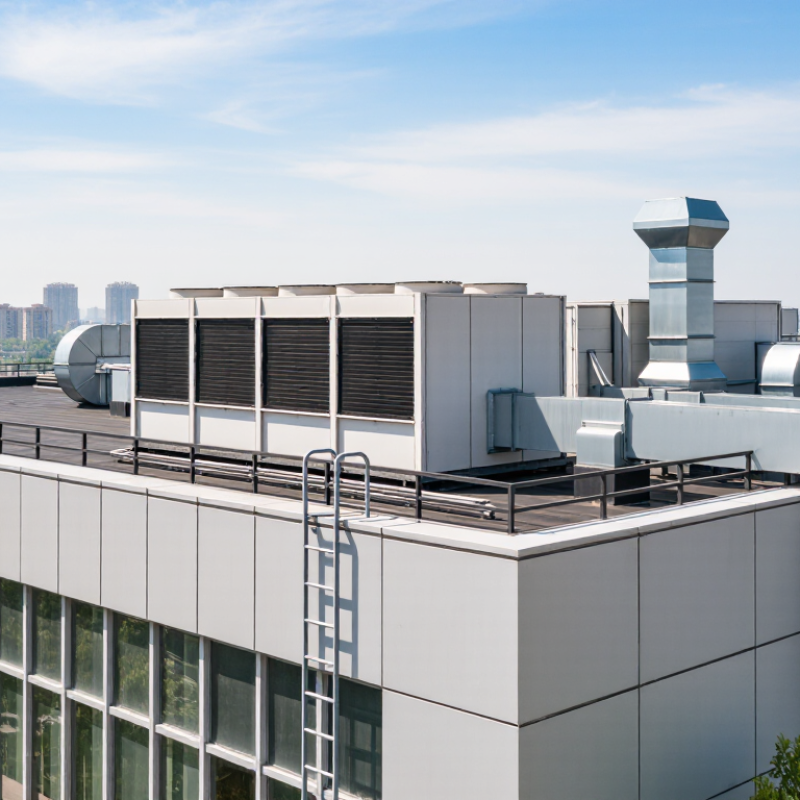
An air heat exchanger transfers heat between two air streams without mixing them directly. Its role is simple: recover useful energy, reduce heating or cooling demand, and improve indoor ventilation. In winter, warm exhaust air can preheat incoming outdoor air. In summer, the process can work in reverse.
Most units use plates, tubes, or rotating media to separate the airflow paths. Heat moves through a conductive surface because of a temperature difference.
Crossflow designs are compact, while counterflow designs usually achieve stronger heat recovery. Some systems also transfer moisture through a permeable core. This can reduce excessive dryness during cold weather.
Real performance depends on more than the advertised recovery rate. Check airflow volume, temperature efficiency, pressure drop, noise, filter access, and condensation control. A clean filter matters. A blocked filter can quietly reduce ventilation and increase fan energy.
Field measurements with temperature sensors and airflow instruments provide more trustworthy results than catalogue figures alone. I have seen installations fail because the duct layout was ignored. The exchanger was suitable, but the system could not deliver balanced airflow.
Climate should guide the choice. Humid regions may require drainage and frost protection. Cold regions may need defrost control.
Controls can adjust fan speed when occupancy changes, but sensors need proper placement and calibration. A smaller unit may save space, yet it could struggle during peak conditions. That trade-off deserves a careful review.
How to Choose an Air Heat Exchanger in 2026?
Match Heat Exchanger Types to Airflow and Process Requirements
Choosing an air heat exchanger starts with the airflow, not the catalog image. Measure volume, temperature, humidity, pressure, and contamination levels at the actual operating point. Clean, steady air may suit a plate heat exchanger with compact channels. Dusty air often needs wider passages and easier access for cleaning. Crossflow designs can simplify installation, while counterflow designs usually recover more heat from the same footprint. The best choice depends on the process.
Do not ignore pressure drop. A highly efficient core can increase fan energy when passages are too narrow. For humid exhaust, check condensation risk and drainage details. Corrosive vapors require compatible materials and protective construction. In practical plant assessments, inaccurate airflow readings create more trouble than complicated calculations. That is easy to underestimate. Verify readings with calibrated instruments and review seasonal conditions before selecting the exchanger.
Tips: Define the normal and peak airflow separately. Confirm whether filters, dampers, and fans will change resistance over time. Leave service clearance around the core. Ask for tested performance data at your operating temperatures, not only advertised efficiency. A small safety margin helps, but excessive oversizing can reduce control quality and increase cost. Recheck the selection after installation, because real duct losses may differ from the original design.
| Heat Exchanger Type | Heat Transfer Principle | Typical Airflow Range | Typical Sensible Heat Recovery | Moisture Transfer | Typical Pressure Drop | Cross-Contamination Risk | Best-Fit Applications | Main Selection Considerations |
|---|---|---|---|---|---|---|---|---|
| Fixed Plate Air-to-Air | Two air streams pass through alternate channels separated by flat plates. Heat is transferred through the plates without direct mixing. | Approximately 500–100,000 m³/h per module, depending on size and configuration. | Approximately 50–80% sensible effectiveness. | Usually no moisture transfer with standard non-permeable plates. Enthalpy membranes can transfer moisture. | Approximately 100–300 Pa per air side at rated airflow. | Very low when properly sealed; suitable where exhaust and supply air must remain separated. | Commercial buildings, offices, schools, hospitals, clean areas, and general HVAC ventilation. | Check face velocity, frost protection, condensate drainage, sealing quality, and required access for cleaning. |
| Rotary Heat Wheel | A rotating matrix alternately contacts the exhaust and supply air streams and transfers heat as it rotates. | Approximately 2,000–200,000 m³/h per wheel, with larger systems possible. | Approximately 60–85% sensible effectiveness; total effectiveness can also be high with hygroscopic media. | Yes, when a hygroscopic or enthalpy-transfer matrix is selected. | Approximately 100–250 Pa per air side at rated airflow. | Low to moderate; purge sections and correct pressure relationships are needed to limit carryover. | Large air-handling units, offices, airports, factories, data centers, and climates with high ventilation loads. | Evaluate purge-sector design, wheel speed, leakage, motor reliability, carryover requirements, and cleaning access. |
| Heat Pipe Heat Exchanger | Sealed heat pipes transfer heat through evaporation and condensation of an internal working fluid. The air streams remain separate. | Approximately 1,000–50,000 m³/h per bank, depending on tube rows and module size. | Approximately 45–70% sensible effectiveness. | No intentional moisture transfer. | Approximately 75–250 Pa per air side at rated airflow. | Very low because there are no moving parts and no direct air-stream connection. | Air-conditioning systems, laboratories, electronics facilities, hospitals, and applications requiring passive operation. | Confirm installation orientation, freeze protection, coil bypass, tube-row arrangement, and required sensible-only recovery. |
| Run-Around Coil Loop | Separate coils in the supply and exhaust ducts are connected by a pumped water-and-glycol circuit. | Approximately 2,000–150,000 m³/h per air-handling system; scalable for separated or remote ducts. | Approximately 40–65% sensible effectiveness. | No direct moisture transfer. | Approximately 100–400 Pa per air side, plus pump and piping losses. | Extremely low; supply and exhaust ducts can be physically remote and fully isolated. | Healthcare isolation areas, laboratories, industrial exhaust, retrofit projects, and buildings with separated air systems. | Account for pump energy, glycol concentration, coil fouling, freeze protection, pipe routing, and control-valve authority. |
| Shell-and-Tube Air-to-Air | Air flows through tubes or shell passages while heat transfers through a solid metal wall between the two air streams. | Approximately 1,000–60,000 m³/h per unit, subject to tube bundle size and allowable pressure drop. | Approximately 40–65% sensible effectiveness. | No intentional moisture transfer. | Approximately 150–500 Pa per air side at rated airflow. | Very low when tube and shell sides are correctly sealed and tested. | Industrial process exhaust, high-temperature air service, corrosive environments, and applications requiring robust construction. | Specify material compatibility, operating temperature, fouling tendency, cleanability, thermal expansion, and inspection access. |
| Liquid Desiccant Heat and Moisture Exchanger | A liquid desiccant absorbs or releases water vapor while transferring sensible and latent energy between air streams or process stages. | Approximately 1,000–50,000 m³/h per system, depending on absorber and regenerator design. | Approximately 50–75% sensible effectiveness; latent performance depends strongly on solution concentration and temperature. | Yes; designed for simultaneous heat and humidity control. | Approximately 150–500 Pa per air side, excluding liquid-pump losses. | Potential for desiccant carryover if eliminators, droplet control, or maintenance are inadequate. | Humidity-sensitive manufacturing, food processing, museums, pharmaceutical production, and dedicated outdoor-air systems. | Control solution concentration, corrosion protection, carryover prevention, regeneration energy, and chemical maintenance. |
Note: Performance values are typical preliminary-selection ranges rather than guaranteed ratings. Final selection should use certified manufacturer data at the actual airflow, entering air temperatures, humidity levels, altitude, fouling conditions, allowable pressure drop, and required leakage class.
How to Choose an Air Heat Exchanger in 2026?
Choosing an air heat exchanger in 2026 requires more than comparing rated heat recovery percentages. In field assessments, I start with design airflow, entering temperatures, humidity, and operating hours. These values reveal the exchanger’s real thermal duty. A unit showing 85% sensible effectiveness may perform differently at 40% airflow. Check both sensible and latent performance when moisture matters. Small details matter.
Pressure drop deserves equal attention. Record resistance across the exchanger at the actual airflow, not only at the catalog test point. A 180 Pa pressure drop can force a fan to work much harder than a 90 Pa design. Estimate fan energy using airflow, pressure rise, and total fan efficiency. Then compare annual kilowatt-hours under occupied and low-load schedules. Clean filters, frost control, and uneven airflow can change results. I have seen commissioning data miss reality because sensors were poorly placed. That weakness should be acknowledged.
Choose a core that meets thermal targets without creating an oversized fan penalty. Review performance curves, test conditions, acoustic limits, and maintenance access before approval. Ask for data at several airflow rates and temperatures. Independent testing improves confidence, but site verification remains valuable. A practical trial can measure supply temperature, exhaust temperature, airflow, and pressure together. Leave room for uncertainty. Real buildings rarely behave perfectly.
Evaluate Thermal Performance, Pressure Drop, and Energy Use
The comparison uses representative engineering values for a 2.0 m³/s airflow rate, 4,000 operating hours per year, and 60% total fan and motor efficiency. Higher thermal effectiveness improves heat recovery, while lower pressure drop generally reduces annual fan energy consumption. Actual results depend on airflow, temperature difference, fouling, control strategy, and installation conditions.
How to Choose an Air Heat Exchanger in 2026?
Choosing an air heat exchanger in 2026 starts with the air, not the catalogue. The IEA’s Energy Efficiency 2023 report says buildings consume about 30% of global final energy. That figure makes recovery efficiency important, but material selection decides whether efficiency survives. Use coated aluminum for ordinary indoor air. Choose stainless steel where salt, chemicals, or persistent moisture attack surfaces. Plastic cores can resist corrosion, yet they may soften under high temperatures.
Environmental data should be measured at the intake. Record dry-bulb temperature, humidity, dust loading, salt exposure, and corrosive gases across seasons. The ASHRAE Handbook—HVAC Systems and Equipment identifies fouling, condensation, and corrosion as major heat-transfer concerns. A coastal intake needs stronger corrosion protection than a clean office roof. A dusty workshop needs accessible filters and a larger service allowance. Do not size from average weather alone. Peak conditions expose weak assumptions.
Maintenance requirements deserve a line-by-line review. U.S. Department of Energy building guidance emphasizes commissioning, inspection, and control verification for dependable HVAC performance. Specify removable panels, drain access, washable components, and differential-pressure sensors. Check whether technicians can clean the core without damaging seals. A six-month inspection interval may suit one site, but not another. After one dusty season, that schedule may look optimistic. Leave space for replacement, not just installation. A perfect laboratory rating can disappoint when access is poor.
Choosing an air heat exchanger starts with measured airflow, not a catalogue picture. Calculate room volume, occupancy, ventilation demand, and expected temperature differences. A unit that is too small may run continuously and still leave stale air. An oversized model can cost more and cycle inefficiently. Measure twice. Include pressure loss from filters, ducts, grilles, and bends. A heating engineer should verify these figures before purchase.
Installation constraints often decide the practical choice. Check ceiling height, service clearance, drain routing, electrical access, and outdoor duct length. In a compact utility room, a technically efficient unit may become frustrating if its filter cannot be removed safely. Allow space for condensate protection and future cleaning. Noise also matters. A bedroom installation needs careful fan-speed and duct-design checks, not just a published sound figure.
Compare total cost rather than the initial invoice. Purchase price, ductwork, controls, commissioning, electricity, filter replacement, and servicing all affect long-term value. A higher-efficiency exchanger may repay its premium when used for many hours each day, but local energy prices change that calculation. I have seen estimates ignore access work, then exceed budget by a painful margin. That is a useful warning. Ask for measured performance, warranty terms, spare-part availability, and realistic maintenance intervals. A simple lifecycle spreadsheet helps, although it cannot predict every installation surprise.