What Is an EDFA Optical Amplifier and How Does It Work
Modern networks carry more data across longer distances than ever. The ITU’s Facts and Figures 2023 counted about 5.4 billion Internet users worldwide. Cisco’s Annual Internet Report projected global IP traffic to reach 396 exabytes per month by 2022. These figures explain why optical transport systems need efficient signal extension. More traffic needs stronger links.
An Edfa Optical Amplifier strengthens optical signals without converting them into electrical form. It commonly uses erbium-doped fiber, optimized for the 1,550-nanometer transmission window. A 980- or 1,480-nanometer pump laser energizes erbium ions inside the fiber. When signal photons pass through, stimulated emission creates additional photons with similar wavelength and phase. This produces optical gain. No electrical regeneration occurs. The amplifier can therefore support long fiber spans, submarine systems, and dense wavelength-division multiplexing networks. Yet gain is not perfectly uniform. Noise, saturation, and amplified spontaneous emission can reduce performance.
Physics is unforgiving.
Engineers place EDFAs at carefully calculated points along a link. They measure output power, gain flatness, noise figure, and optical signal-to-noise ratio. In a dense WDM system, a gain-flattening filter may balance several channels. ITU-T Recommendations G.661 and G.662 provide recognized terminology and characteristic guidance for optical amplifiers. Industry analyses, including Cignal AI’s Optical Network Hardware research, also track the continuing importance of optical amplification in high-capacity networks. Laboratory specifications can look impressive. Field performance may differ. This distinction matters. By examining the pump source, doped fiber, gain process, and operating limits, readers can understand what an Edfa Optical Amplifier does and where its practical advantages end.
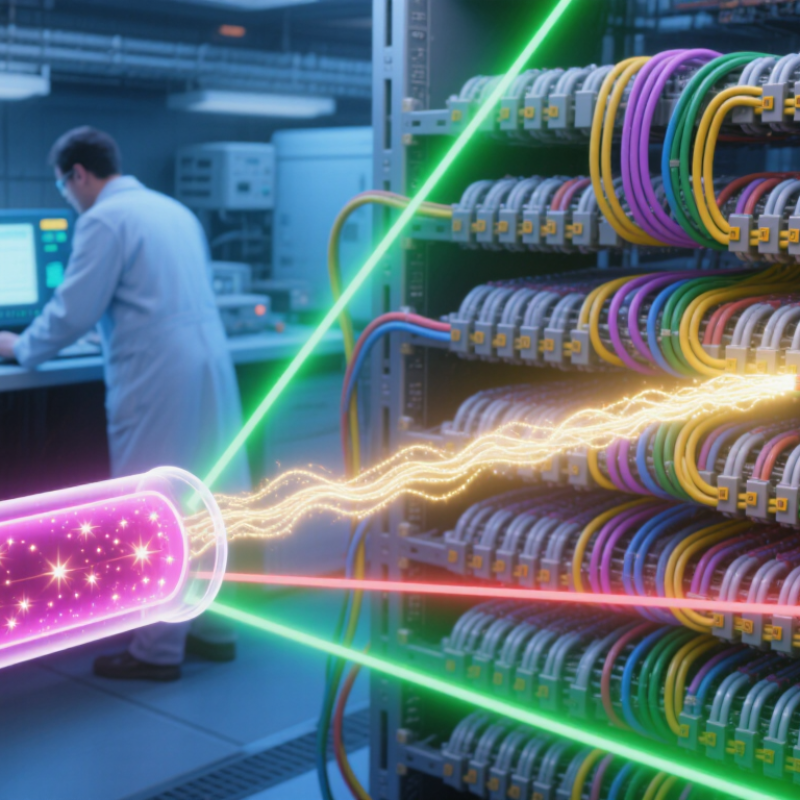
EDFA Optical Amplifier: Definition and Basic Purpose
An EDFA, or erbium-doped fiber amplifier, is an optical device that strengthens light signals in fiber networks. Its basic purpose is clear: restore signal power after transmission losses. It works without converting the optical signal into an electrical one. This makes it useful for long-distance links, where fiber attenuation gradually weakens each pulse.
Inside the amplifier, a pump laser supplies energy to erbium ions in a short fiber section. These ions absorb the energy and reach an excited state. When signal photons pass through, the ions release matching photons. This stimulated emission increases optical power and preserves the signal’s wavelength. No electrical regeneration occurs. Most EDFAs operate near the 1550-nanometer window, where many communication fibers have low attenuation. Engineers still check gain, noise figure, saturation, and input power before deployment.
In practical systems, an EDFA can compensate for losses from long fiber spans, connectors, and passive components. It cannot repair a damaged signal or remove all accumulated noise. It amplifies noise too. A useful field lesson is that more gain is not always better. Excessive gain may cause saturation, distortion, or unstable network performance. Technicians usually measure output power and optical signal quality under real operating temperatures. The basic definition sounds simple, but installation details often decide whether the amplifier performs reliably.
Core Components and Their Functions
An EDFA, or erbium-doped fiber amplifier, strengthens optical signals without converting them into electrical signals. Its main component is a short section of erbium-doped fiber. Erbium ions absorb energy from pump lasers, usually near 980 or 1480 nanometers. This energy creates an excited state inside the fiber.
The input signal passes through this energized fiber. When signal photons interact with excited erbium ions, they release matching photons. The signal becomes stronger while preserving its wavelength and data pattern. Pump lasers provide excitation, optical isolators reduce unwanted reflections, and wavelength-selective couplers combine pump and signal paths. A gain-flattening filter can balance amplification across multiple channels. However, real EDFAs are not perfectly uniform. Noise, saturation, and temperature changes can affect performance.
Tips: Check input power, gain, and output power during installation. Excessive input power may cause saturation. Low input power can expose amplified spontaneous emission noise. Keep connectors clean, because a small particle can create noticeable loss. In field testing, I would also compare readings at different wavelengths instead of trusting one measurement. That extra check often reveals uneven gain. Cooling helps, but it does not fix poor fiber connections. Calibration records matter. So does patience.
Signal Path and Energy Conversion Process
An EDFA Optical Amplifier: Signal Path and Energy Conversion Process
An EDFA boosts optical signals without converting them into electrical signals. The incoming data travels through a short erbium-doped fiber section. A wavelength-selective coupler introduces pump light from a laser source, commonly near 980 or 1480 nanometers. The signal and pump share the same fiber path.
Inside the doped fiber, erbium ions absorb pump photons and move into higher energy states. When a weaker signal photon passes nearby, it stimulates an excited ion to release another photon. The new photon matches the signal’s wavelength, phase direction, and information pattern. Optical power increases through this repeated process. No data is recreated. It is copied through stimulated emission.
At the output, an isolator reduces reflected light, while monitoring circuits check gain, temperature, and pump performance. Practical measurements often reveal uneven gain across different wavelengths. This matters in dense systems. Excessive input power can also saturate the amplifier, limiting additional gain. Noise from spontaneous emission then becomes more noticeable. A clean connector helps, but it cannot fix poor design. This part is easy to underestimate. Engineers usually verify insertion loss, output power, and noise figure with calibrated optical instruments. Even careful testing may miss gradual drift caused by aging components or changing operating temperature.
Key Benefits, Limitations, and Common Applications
What Is an EDFA Optical Amplifier and How Does It Work
An EDFA amplifies light directly, without converting it into an electrical signal. It uses erbium-doped fiber and a pump laser, usually near 980 or 1480 nanometers. The pump excites erbium ions, which release energy when passing optical signals stimulate them. Most EDFAs operate in the C-band, around 1530–1565 nanometers. ITU-T G.662 defines key optical amplifier characteristics, supporting consistent network design.
The benefits are practical. EDFAs can provide roughly 20–30 dB of gain and support many wavelength channels simultaneously. They improve span length, reduce regeneration sites, and simplify dense wavelength-division multiplexing systems. Cisco’s Annual Internet Report projected global IP traffic could reach 396 exabytes per month by 2022, showing why scalable optical capacity matters. EDFAs serve long-haul terrestrial links, data-center interconnects, cable television networks, and submarine systems.
However, amplification is not regeneration. Noise remains. Typical noise figures may range from 4–6 dB, depending on design and operating conditions. Gain saturation can also appear when many channels share limited output power. Wavelength tilt is another concern. Engineers often add gain-flattening filters and carefully balance power across spans. The trade-off is easy to underestimate. A stronger amplifier is not always better. Excessive power can worsen nonlinear effects, while weak power reduces link margin. Real networks need testing, monitoring, and sometimes a less elegant compromise.


