Who Is the Best Contact Ball Bearing Supplier in China?
Choosing the best Contact Ball Bearing supplier in China takes more than comparing unit prices. Buyers must assess contact angle, load capacity, operating speed, noise, sealing, and expected service life. A bearing that looks identical in a catalogue may perform differently on a production line. Small details matter.
Industry reports help frame the decision. SKF’s 2023 Annual Report recorded net sales of SEK 103.9 billion, illustrating the scale and technical demands of the global bearing sector. Grand View Research’s global bearing-market analysis also tracks continued demand across automotive, industrial, and machinery applications. These reports describe the broader market; they do not certify any individual Chinese supplier. That distinction matters.
Bearing analyst Tedric A. Harris’s work in Rolling Bearing Analysis emphasizes evaluating bearings under real operating conditions. Put plainly, a catalogue rating is only part of the story. A careful supplier comparison should examine material traceability, dimensional inspection, noise testing, lubrication options, and documented quality controls. Ask for test records. Request samples. Check consistency across batches. Then compare communication and after-sales support, not just price. This outline examines how buyers can judge Chinese manufacturers with evidence, technical questions, and realistic expectations. No supplier is automatically the best for every application. The right choice depends on fit, verified performance, and the conditions your equipment actually faces.
What Contact Ball Bearings Are and Where They Are Used
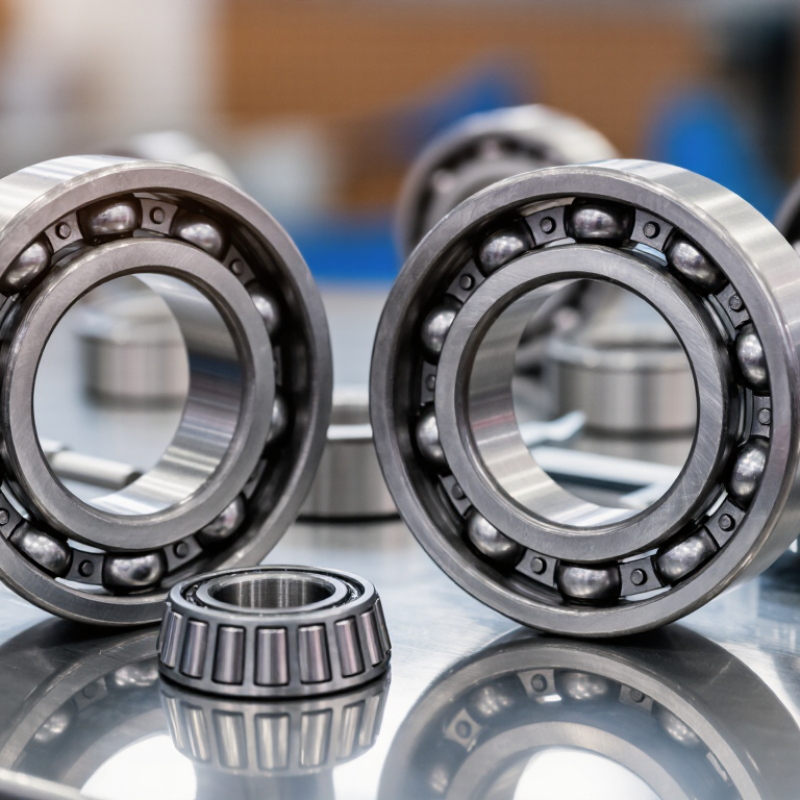
Contact ball bearings, often called angular-contact ball bearings, use curved raceways and balls to carry loads. Their contact angle lets them support radial loads and axial loads at the same time. A single-row bearing typically handles axial force in one direction, while a matched pair can manage forces from both directions. The exact capacity depends on bearing size, contact angle, speed, and installation.
They are used in machine-tool spindles, pumps, compressors, gearboxes, and some electric motors. In a workshop, a spindle may need to turn quickly while holding a cutting tool steady; bearing selection affects heat, vibration, and accuracy. Pumps face a different mix of shaft load and operating conditions. Small details matter. Lubrication, shaft fit, alignment, and dust protection can all influence service life. A common oversight is choosing by dimensions alone. That can work on paper, but it may not reflect real operating loads. Engineers should check the full duty cycle and installation conditions before selecting a bearing.
Who Is the Best Contact Ball Bearing Supplier in China?
Common Contact Angles in Angular Contact Ball Bearings
Angular contact ball bearings are designed to support combined radial and axial loads. Common contact-angle options include 15°, 25°, 30°, and 40°, although availability varies by bearing series and supplier. Larger contact angles generally support greater axial loads, while smaller angles are often used where higher speeds are important. Typical applications include machine-tool spindles, pumps, compressors, and automotive transmissions.
How China’s Contact Ball Bearing Market Is Structured
China’s contact ball bearing market includes specialized manufacturers, larger production groups, component suppliers, and trading companies. These businesses do not all serve the same buyers. Some focus on standard deep-groove bearings, while others handle custom dimensions, seals, or cage materials. A trading firm may coordinate export orders, but it may not control production or inspection directly.
The supply chain often links steel and component processing with bearing assembly, testing, packaging, and distribution. Capabilities can differ between factories, even when product descriptions look similar. Buyers should check who makes the bearing and who verifies it. Ask for dimensional inspection records, material details, and test information relevant to the intended speed and load. A sample can reveal fit and finish, though it cannot replace ongoing quality checks.
Tips: Share drawings, operating speed, load, temperature, and sealing needs before requesting a quote. Confirm tolerances, lubrication, packaging, and batch traceability in writing. Compare equivalent specifications, not just unit prices. Small details matter. I would still verify production consistency over several orders; a polished sample is not the whole story.
Key Criteria for Evaluating Potential Suppliers
When evaluating a contact ball bearing supplier in China, start with the operating conditions, not the quoted price. Share the required dimensions, load direction, speed, temperature, and lubrication method. Ask how the supplier controls tolerances and verifies contact angle, runout, and surface finish. Small details matter. A bearing that fits on a drawing may still run hot or create noise in a real assembly.
Request material and inspection records for the specific product, then compare them with a sample measurement or third-party inspection. Check whether batch numbers connect finished bearings to production records. Ask how often key dimensions are measured and what happens when results fall outside limits. Clear answers are useful; polished brochures are not proof. Also review packaging, lead times, minimum order quantities, and how technical questions are handled. Slow replies before an order can become a practical problem later. A factory visit may help, but it cannot replace repeatable inspection data. I would not judge a supplier from one sample alone; samples can be unusually well selected. Compare several units and, where possible, confirm performance in your own assembly.
How to Compare Quality, Customization, and Delivery
Who Is the Best Contact Ball Bearing Supplier in China?
How to Compare Quality, Customization, and Delivery
A strong supplier can show how each bearing is inspected, not just promise “high quality.” Ask for material certificates, dimensional inspection records, and traceability from steel batch to finished part. ISO 492 specifies dimensional tolerances, while ISO 281 provides methods for calculating bearing rating life. These standards offer a useful baseline, but they do not replace checking samples under your actual load, speed, and temperature. Request measurements for bore, outside diameter, and radial runout. Paperwork matters. So does a clean, consistent finish.
Customization should be judged through engineering detail: drawing review, cage and seal options, lubrication choice, and tolerance control. Ask how revisions are recorded and approved. A supplier that spots a fit issue before production may save more than one offering a lower unit price. Grand View Research estimated the global bearings market at USD 118.7 billion in 2023 and projected 9.1% annual growth through 2030. That broad market figure is not a contact-ball-bearing quality score; it does show why capacity and delivery planning deserve scrutiny. Request a realistic lead-time breakdown for samples, tooling, production, and shipping, plus evidence of recent on-time performance. I would still treat a quoted date cautiously. Even a tidy scorecard can miss how well a supplier responds when a drawing changes.
How to Choose the Best Supplier for Your Application
Choosing a contact ball bearing supplier starts with the operating conditions, not the lowest quote. Share radial and axial loads, shaft speed, temperature range, duty cycle, and contamination risks. A bearing beside a dusty conveyor needs different sealing and lubrication from one inside a clean, high-speed spindle. Small details matter.
Ask for documented load ratings, dimensional tolerances, material specifications, heat-treatment records, and batch traceability. Under ISO 281, the basic rating life, L10, is the life that 90% of a sufficiently large group of identical bearings are expected to reach or exceed under stated conditions.
Request calculations using your actual load and speed. Catalog life alone can mislead. Check sample measurements and ask how the supplier handles failed inspection results; not every factory explains this clearly.
Grand View Research valued the global ball-bearing market at about US$7.6 billion in 2023, reflecting broad demand across industrial applications. That figure does not prove any supplier’s quality. It does make careful qualification worthwhile.
Compare lead times, minimum order quantities, inspection reports, and engineering response times. Ask for a sample bearing and verify its fit, noise, and temperature rise in your equipment. Real conditions can surprise you. A supplier’s willingness to discuss limits—not just claim precision—can reveal how well they understand your application.


